Global experts confer on healthspan, now a major focus of the global scientific community
Tokyo, Japan, February 13, 2026 – Now that science is helping us live longer, what do we know about living more of our years active, independent and enjoying good health as well?
The science of measuring the years spent in good health – what we call healthspan – is advancing rapidly. Emerging science shows that healthy, well-functioning cells are key to keeping the body strong and functioning its best as we age. Research now suggests that the trajectory of our healthspan may be changed by targeting cellular health – and there is growing evidence of the power of plant compounds to help support the shift.
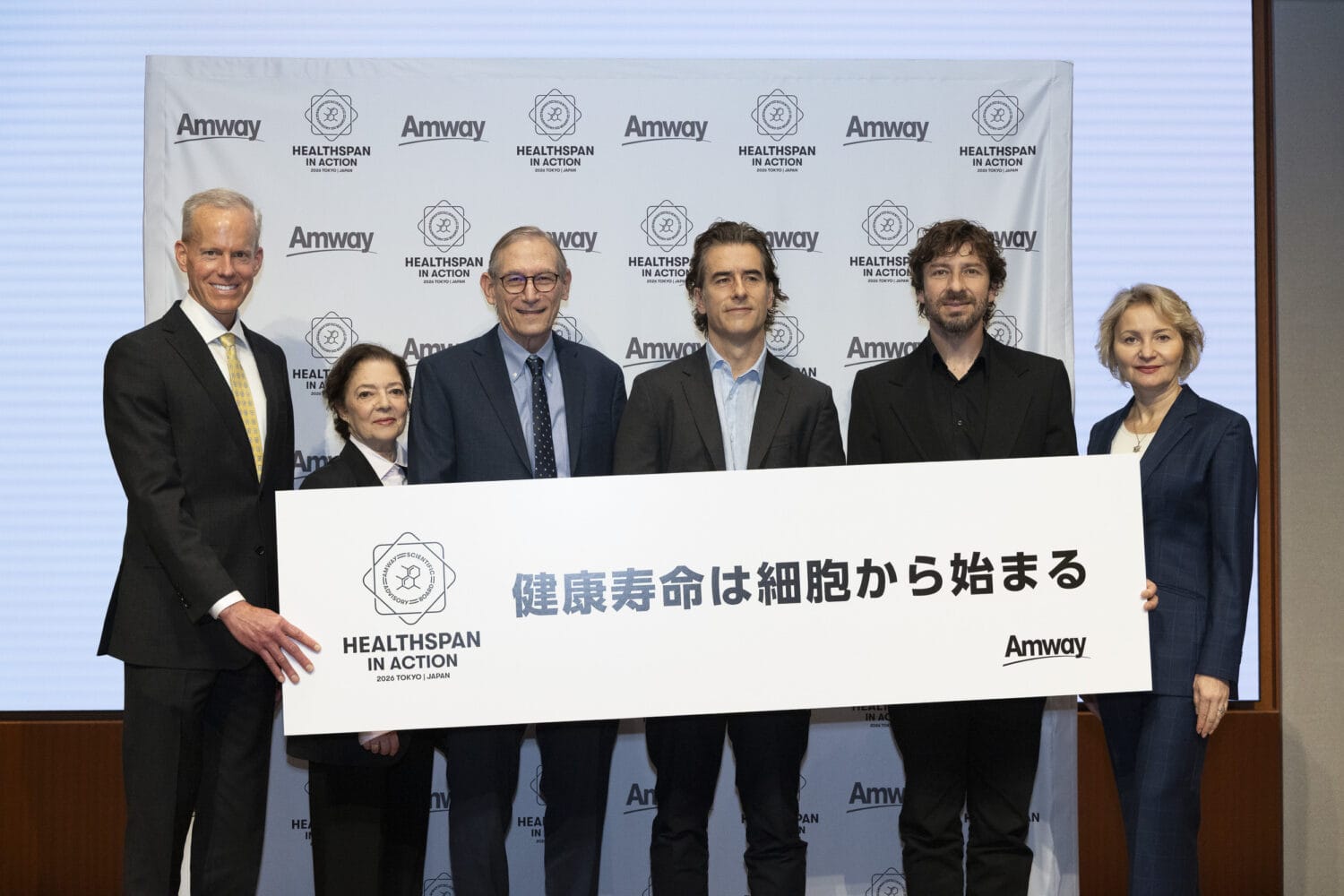
Healthy aging is now a major focus of the global scientific community. Fourteen world-class experts at the forefront of this research just concluded an event sponsored by Amway, a global health and wellbeing company, to discuss significant findings on influencing the healthspan trajectory. Their research is so compelling that Amway held a media seminar to share some of the most important developments beyond the scientific community.
Hailing from universities, institutes and private labs from across the world, many of these thought leaders are also members of the Amway Scientific Advisory Board (SAB). In addition to their independent research, they conduct research sponsored by or in collaboration with Amway scientists. Amway brought them together to discuss what they all are learning about the lifestyle choices, environmental exposure and common factors that affect our cellular health. Topics ranged from how external factors like UV radiation get into the body and cause deeper damage that accelerate aging, to how certain plant extracts support healthy cell function.
The primary takeaways: Healthspan can be measured, predicted and influenced. Inflammation is the key indicator of cellular aging, which is accelerated by environmental exposure, so we need to protect our cells.
The strategic setting
The location was dynamic and strategic: Japan, home of the world’s most rapidly aging society. With aging now considered a major social challenge impacting social security systems and healthcare infrastructure, Japan is known as a center of healthy aging research and development.
“Amway gathers our Scientific Advisory Board members on an annual basis, gaining key insight and learning from these leading experts in their respective fields. The resulting collaboration and sharing that occurs at this event, and throughout the year, significantly propels Amway’s research and innovation efforts,” said Michael Nelson, Amway President and Chief Executive Officer. “The human side of healthspan innovation is a central element for Amway, reflecting our passion for helping people live better lives. We are grateful for the partnership between our esteemed Scientific Advisors and Amway’s deep, experienced team of global scientists.”
Collaborative work between Amway scientists and its Scientific Advisors and collaborators has led to such recent discoveries as a special combination of rosemary and ginger extracts that supports cellular health and healthy aging; and an extract of lab-grown argan plant stem cells that helps skin cells function effectively, enhancing cellular vitality and resilience and slowing the visible signs of aging.
Highlights from key speakers
The media seminar featured four expert speakers sharing research highlights relating to influencing healthspan, inflammation as a key driver of aging and supporting cellular health. Here are excerpts from their presentations.
David Furman, PhD
Amway Scientific Advisory Board Member
Director, Stanford 1,000 Immunomes Project at Stanford School of Medicine and Associate Professor and Chief of the AI Platform at Stanford’s Buck Institute for Research on Aging in the USA
“Based on our research, and the research of many other groups in the world, we know that engaging in healthy lifestyles can extend healthspan and delay decline in function. So how can we understand the biological determinants of healthspan? We engaged in trying to understand the decline in intrinsic capacity, essentially, functional decline. We’re talking about things like hearing capacity or visual acuity or cognitive deterioration. In a study conducted at the University of Toulouse in France, a 10-year study of 1,000 individuals, we collected intrinsic capacity measurements and measured almost one million parameters from blood. Using sophisticated AI and machine learning tools, we were able to develop a “clock” that enables us to differentiate those individuals who were declining faster in intrinsic capacities versus those that are maintaining intrinsic capacities over time. We’re using this clock now to identify interventions that can delay functional decline by 10 and 20 biological age years. I’m very, very excited for what’s coming.”1
David Walker, PhD
Amway Scientific Advisory Board Member
Professor, Department of Integrative Biology and Physiology, University of California, Los Angeles, USA
“Can you imagine, if we could slow brain aging by targeting the intestine? My lab and others have shown that the intestine does play a vital role in whole-body, or systemic, aging. One of the key findings is that the function of the intestine as a barrier organ declines with age, so changes that take place within the intestine are driving aging throughout the entire body. It’s clear now that one of the most important changes that occur is the loss of activity of the autophagy pathway, a key cellular recycling pathway that turns over damaged or unnecessary components within our cells. Our recent intervention developed in collaboration with Amway scientists can actually stimulate the machinery of autophagy. Our study in the model organism fruit fly, Drosophila, showed that if we feed normal flies a combination of rosemary extract and ginger extract together, it activates the enzyme AMPK and autophagy within their cells. When we activate this pathway, it slows aging within the intestinal system and throughout the entire body, including the brain.”2
Karima Djabali, PhD
Professor of Epigenetics of Skin Aging at the School of Medicine and Health, Technical University of Munich, in Germany
Amway research collaborator
“We used argan stem cell extract from argan cells grown in vitro to treat our human skin cell platform, using fibroblasts from normal individuals and fibroblasts from a stressed system. We saw, remarkably, that this extract ameliorated the growth of the fibroblasts, ameliorated several functions that are altered during aging, and extended the lifespan in vitro of cells when we cultured them. We saw also that this extract decreased the level of inflammatory factors that were secreted by the cells. Furthermore, we demonstrated that argan extract containing key antiaging compounds can maintain and reset the vitality of cells such as fibroblasts, maintain the stem-cell-ness of adult stem cells, which are needed for regeneration, and maintain the extracellular matrix that is crucial to maintain the tissue in a good fashion.”3
Gary Fisher, PhD
Amway Scientific Advisory Board Member
Endowed Professor of Molecular Dermatology at the University of Michigan, USA and Director of the University’s Photobiology and Aging Research Laboratory
“We have transitioned our laboratory’s knowledge about the molecular basis for skin aging to try and understand the connection between skin aging and whole-body, or systemic, aging. To understand whether very mild environmental damage to skin would cause changes in blood markers associated with systemic aging, we performed a study with 20 middle-aged women that we exposed to very, very mild sunlight – the kind you would get walking to the parking lot on three successive days. We measured whether there were changes in the blood markers related to this skin exposure and found that a number of biomarkers associated with biological aging were elevated. So we see that very mild environmental exposure can produce mediators that are associated with increased systemic aging. These are released from the skin, go into circulation, go into the blood, they may impact the internal organs and they drive a process referred to as inflammaging, the connection between inflammation and aging that is emerging as a primary concept within the field of aging.” 4
Established in 2003 the Amway Scientific Advisory Board is a global network of industry-leading experts in dermatology, gut health, nutrition, healthy weight, the mechanisms of aging, food sciences and more that Amway engages to complement its internal knowledge. They advise the company on research, offer recommendations and facilitate new collaborations with distinguished institutions.
More than 800 Amway scientists, engineers and technicians are passionately pursuing holistic solutions for today’s health + wellbeing challenges. As the global pace of scientific development accelerates, leveraging the advisors’ wide-ranging experience helps the company extend its holistic approach to innovation.
About Amway
Amway is an entrepreneur-led health and wellbeing company based in Ada, Michigan, U.S. It is committed to helping people live better, healthier lives across more than 100 countries and territories worldwide. Top-selling brands for Amway are Nutrilite™, Artistry™ and XS™ – all sold exclusively by entrepreneurs who are known as Amway Business Owners. Amway is the No. 1 direct selling business in the world, according to the 2023 Direct Selling News Global 100 list. For company news, visit: https://www.amwayglobal.com/newsroom.
1David Furman, PhD, speaking at Healthspan in Action 2026 sponsored by Amway. Tokyo, Japan, February 6, 2026.
2David Walker, PhD, speaking at Healthspan in Action 2026 sponsored by Amway. Tokyo, Japan, February 6, 2026.
3Karima Djabali, PhD, speaking at Healthspan in Action 2026 sponsored by Amway. Tokyo, Japan, February 6, 2026.
4Gary Fisher, PhD, speaking at Healthspan in Action 2026 sponsored by Amway. Tokyo, Japan, February 6, 2026.